
NAM JEA HYUN Solo Exhibition
The Night Dreams Bloom
Exhibition Period
2026. 10. 12 – 10. 24
Collast Seongsu
Opening Hours 12:00 – 19:00
※ Closed on Sundays, Mondays and public holiday
In Nam Jea Hyun’s paintings, the moon offers a clear sense of direction. Trees, animals, and cars inhabit the landscape, while whales drift through the night sky. As beings of different scales and positions meet naturally within a single frame, familiar measures of distance and proportion begin to loosen.
For the artist, the moon is both a destination for human wishes and a symbol of an ideal realm. To look at the moon gradually becomes a way of looking again at what one truly longs for. Whales and cars become figures of movement, transforming familiar landscapes into scenes of travel.
The Night Dreams Bloom follows this movement. The world itself does not necessarily change; rather, when familiar measures temporarily loosen, the distance we are able to see—and the range within which the mind can move—begins to expand.
The moon remains in place, while the beings drawn toward it continue to move. The journey in Nam’s paintings begins by discovering, within a world we thought we already knew, a direction we have not yet taken—and allowing the mind to move toward it.
"거대한 땅덩어리가 숨을 내쉬니, 그 이름을 바람이라 한다." 『장자』 「제물론」의 말처럼, 옛사람들에게 대지는 숨 쉬는 하나의 몸이었고, 동양의 화론이 그림에 요구한 제1원칙 또한 기운생동(氣韻生動) — 화면이 살아 숨 쉬는가 — 였다.
이번 전시는 그 오래된 명제를 400호와 480호의 화면들로 마주 세운다. 시야를 넘어서는 화면 앞에서 관람은 바라보는 일이 아니라 들어가는 일이 된다. 이재열의 〈산수몽〉은 준법의 선을 들숨과 날숨처럼 거듭 포개어 쌓은 감정의 지형이고, 영재의 〈우린 다시 만났어 II〉의 밤바다는 흑연을 손으로 수만 번 채워 넣은 애도의 화면이다 — 그 위에서 고래와 고양이가 다시 만난다. 두 거대한 화면 사이, 서연의 황금빛 들판은 전시가 숨을 고르는 자리다.
세 작가는 모두 겹겹이, 천천히, 쌓는다. 우리가 화면 앞에서 느끼는 압도는 크기가 아니라 그 호흡이 축적된 시간의 무게에서 온다. 그 호흡의 속도에 잠시 당신의 숨을 포개어 보시길.
당신의 장소는, 지금 어디에 있는가.
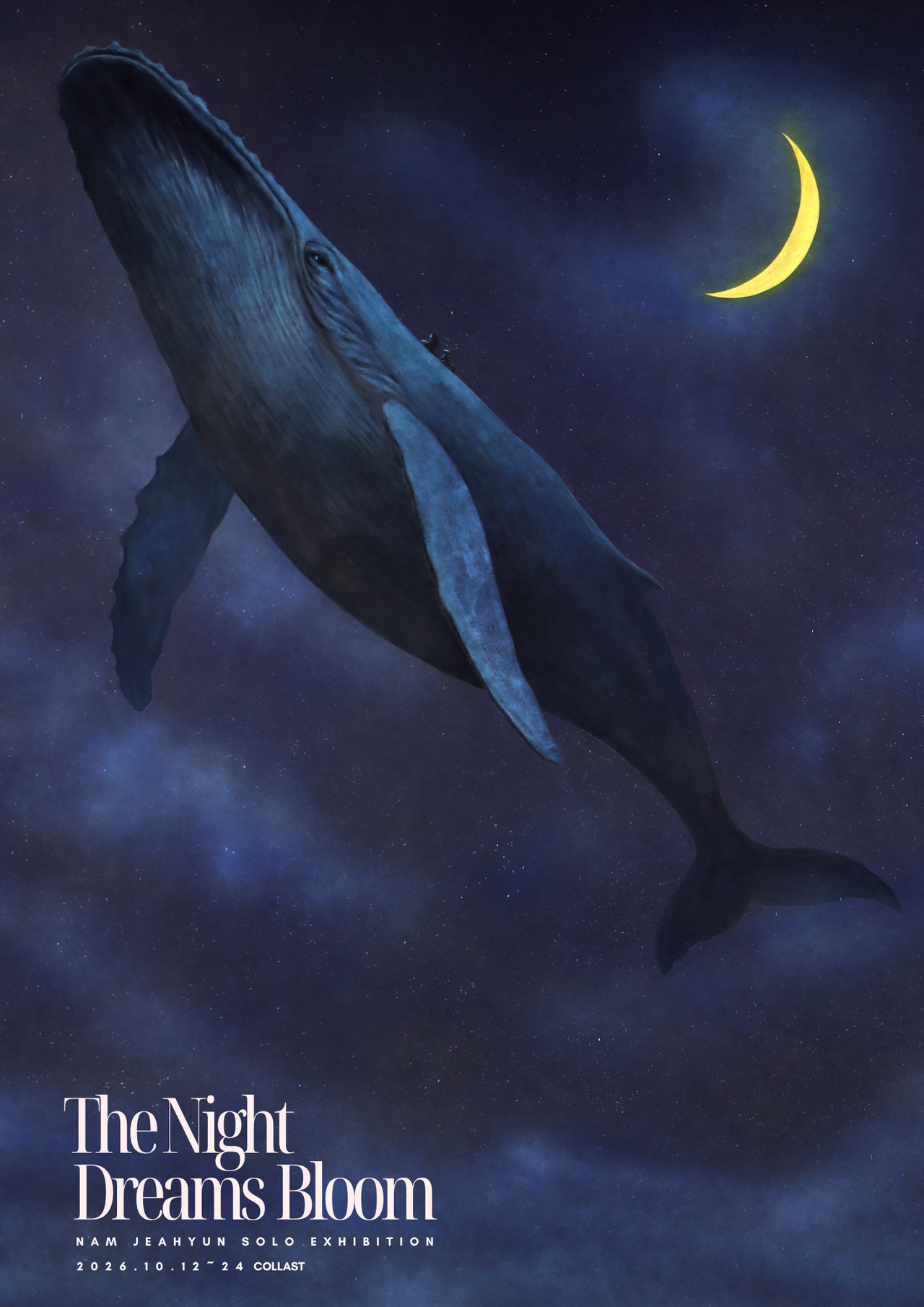
NAM JEA HYUN Solo Exhibition
Exhibition Prose
The Night Dreams Bloom
The night was warmer than I had expected. It was dark, but not cold, and the wind was gentle enough to make me want to keep walking. The air felt too good to waste by going straight home. I turned in a direction that would take me the longer way.
During the day, everything seemed to know its purpose. Buildings had doors to enter, roads had destinations, and time moved toward whatever came next. When night arrived, those firmly assigned purposes began to loosen. A few lights remained in the windows, holding on late into the evening before going out one by one.
The moon was bright, as though it had been placed within a painting. The night I had meant simply to pass through held me there for a moment. To look at another person for a long time usually requires some kind of reason, but the moon asked for none. I could look as long as I wanted, could wish for something unreasonable, and it would never make me feel self-conscious. After standing before it for a while, I found myself thinking of who I had been long ago.
As a child, I had many wishes. The time ahead of me was white, like a sheet of paper no sentence had yet touched. It meant that anything could be written there, and also that nothing had yet been written. It seemed I could place anything anywhere I wanted, and if I did not like what was there, I could simply turn to the next page.
As I grew older, I learned that the next page usually carries the one before it along. Even sentences I thought I had erased would show through faintly. Somewhere in the process of learning how to live, it became easier not to look too closely at certain wishes. Many of them lost their names along the way. But one, strangely, remained to the very end. Most of the time I lived as though it were no longer there, yet in very quiet moments, it would let its pulse show from somewhere deep inside me. Tonight was one of those moments. In front of the moon, it felt all right to loosen what I had kept bound for so long. Had I been speaking to another person, I would probably have revised my words several times before saying them aloud—making the wish not too large, not too foolish, only as big as something that might seem possible.
But with the moon, there was no need.
The moon asked nothing. I offered it the wish I had carried with me, exactly as it was. Even a wish made to the moon did not need to be rewritten according to the grammar of reality.
Then a whale passed above the buildings. It swam toward the moon with the ease of a creature that felt no regret at having left the sea behind. Each time its tail moved, the night seemed to slide slowly backward. Down below, people were waiting for the light to change.
The light turned green. We were free to go. The whale and I.
The whale crossed over several buildings, and I walked a little farther than I usually did. Under the moonlight, even a road I knew well seemed to hold a direction I had never taken. I could not tell which of us was following whom. For a while, we were simply moving in the same direction.
My phone vibrated in my pocket. It was a reminder for something scheduled the next morning. Only then did I look at the time. The things that had loosened for a while began to settle back into their places. I turned off the screen and headed home.
I did not mind that tomorrow was coming. Tomorrow, too, would bring a day that was mine to live. But my breathing had grown a little deeper. As though a door long kept closed had opened without a sound, fresh air slowly found its way in. Among all that remained unchanged, time began to move in a slightly different way.
Each time I turned a corner, the moon disappeared behind a building and then appeared again. After it happened a few times, I stopped checking.
I knew roughly where it was.
Exhibition Concept & Text by Yeseul Lee | Gallery COLLAST
This exhibition prose is a literary reimagining based on Nam Jea Hyun’s artistic practice and artist statement.
남재현 개인전
전시 산문
《꿈이 피어나는 밤》
밤은 생각보다 따뜻했다. 어둡기는 했지만 서늘하지 않았고, 오래 걸어도 좋을 만큼 바람이 얌전했다. 곧장 집으로 들어가기에는 공기가 아까웠다. 나는 평소보다 먼 쪽으로 방향을 틀었다.
낮에는 모든 것이 제 쓰임을 알고 있었다. 건물에는 들어갈 문이 있었고, 길에는 도착할 곳이 있었으며 시간은 다음 일을 향해 흘렀다. 밤이 오자 그 견고한 쓰임들이 조금 느슨해졌다. 유리창에 남은 불빛 몇 개가 늦게까지 버티다가 하나씩 꺼졌다.
달은 한 폭의 그림 속에 놓인 듯 밝았다. 지나치려던 밤이 거기서 한 번 붙들렸다. 사람을 오래 바라보려면 대개 이유가 필요하지만 달은 그렇지 않았다. 오래 보아도, 터무니없는 것을 바라더라도 눈치를 줄 일이 없었다. 그 앞에 한동안 머물자 오래전의 내가 자연스럽게 떠올랐다.
어린 나는 바라는 것이 많았다. 그때 내 앞에 놓인 시간은 문장이 아직 닿지 않은 종이처럼 희었다. 무엇이든 쓸 수 있다는 뜻이었고 아무것도 쓰이지 않았다는 뜻이기도 했다. 어디에 무엇을 놓아도 될 것 같았고 마음에 들지 않으면 다음 장으로 넘기면 그만이었다.
살아보니 다음 장이라는 것은 대개 앞장을 데리고 왔다. 지운 줄 알았던 문장도 희미하게 비쳤다. 살아가는 법을 익히는 동안, 몇몇 바람은 오래 들여다보지 않는 편이 나았다. 많은 바람이 그 사이 이름을 잃었다. 그런데 하나는 이상하게 끝내 남았다. 평소에는 없는 듯 지내다가도, 아주 조용한 순간이면 마음 깊은 곳에서 제 박동을 슬쩍 드러내곤 했다. 오늘이 그랬다. 달 앞에서는 묶어두었던 마음을 조금 풀어도 괜찮을 것 같았다. 사람에게라면 말을 꺼내기 전에 몇 번쯤 고쳐 말했을 것이다. 너무 크지 않게, 우습지 않게, 가능해 보일 만큼만.
그런데 달에게는 그럴 필요가 없었다. 달은 아무것도 묻지 않았다. 나는 간직해 온 바람을 있는 그대로 달에게 내어놓았다. 달에게 하는 부탁까지 현실의 문법으로 고쳐 쓸 필요는 없었다.
그때 건물 위로 고래 한 마리가 지나갔다. 고래는 바다를 두고 온 것에 조금도 미련이 없는 몸짓으로 달 쪽을 향해 헤엄쳤다. 꼬리를 움직일 때마다 밤이 천천히 뒤로 밀렸다. 아래에서는 사람들이 신호를 기다리고 있었다.
초록불이 켜졌다. 가도 좋았다. 나도. 고래도.
고래는 건물 몇 채를 넘었고 나도 평소보다 조금 더 걸었다. 달빛 아래에서는 늘 알던 길에도 아직 가보지 않은 쪽이 남아 있는 것 같았다. 누가 누구를 따라간 것인지는 알 수 없었다. 다만 한동안 같은 방향이었다.
주머니 안에서 휴대전화가 울렸다. 내일 아침의 일정이었다. 그제야 시간을 보았다. 조금 전까지 느슨했던 것들이 다시 제자리를 찾아가기 시작했다. 나는 화면을 끄고 집 쪽으로 몸을 돌렸다.
내일이 오는 것은 싫지 않았다. 내일도 내 몫의 하루가 있을 것이었다. 다만 조금 전보다 숨이 깊어졌다. 오래 닫혀 있던 문이 소리 없이 열린 듯 새로운 공기가 천천히 안으로 스며들었다. 그대로인 것들 사이로, 아주 조금 다른 시간이 흐르기 시작했다.
모퉁이를 돌 때마다 달은 건물 뒤로 숨었다가 다시 나타났다. 몇 번쯤 그러고 나니 더는 확인하지 않게 되었다.
어디쯤 있는지는 알고 있었다.
전시기획·글 이예슬 | Gallery COLLAST
(본 글은 남재현 작가의 작품 세계와 작가노트를 바탕으로 재구성한 전시 산문입니다.)
• 관람 안내
전시 기간: 2026년 10월 12일 – 10월 24일
전시 장소: 콜라스트 성수 (Collast Seongsu)
관람 시간: 12:00 – 19:00
※ 매주 일요일, 월요일 및 공휴일 휴관
Exhibition Introduction
Exhibition Foreword
The Night Dreams Bloom
In Nam Jea Hyun’s paintings, the moon appears with striking clarity. Around it are trees, animals, and cars, while at times a whale swims through the sky. Suspended at one side of the composition, the moon gently directs the viewer’s gaze. Beneath it, beings of different scales and positions—cars and cities, animals and whales—meet within a single scene. As familiar measures of distance and proportion begin to loosen, new relationships emerge among them.
At this point, Zhuangzi’s notion of you (遊), or wandering, comes to mind. Xiaoyaoyou begins with the enormous fish Kun transforming into the bird Peng and rising into the sky. As one’s position and point of view change, so too does the range of the world one is able to experience. Zhuangzi’s notion of wandering can be understood as a way of shifting a fixed perspective and encountering the familiar world from a different distance and scale.
Nam’s whale evokes a similar sense of movement. The whale does not become a bird. It remains a whale as it moves toward the moon. Keeping its own form, it leaves behind its familiar place, and through that movement alone, a new order begins to take shape within the painting. The automobile brings this sense of movement into the present. An ordinary means of transportation becomes an instrument of travel within a moonlit landscape, allowing reality and an imagined journey to overlap within the same scene. Rather than suggesting Zhuangzi as a direct source for the artist’s work, this offers one way of reading the recurring shifts of movement and perspective across his paintings.
Titles such as A Voyage Toward the Moonlight, A Night Where the Waves of Dreams Flow, and Setting Out on a Moonlight Voyage also carry a sense of progression rather than stillness. They move toward the moonlight, flow like the waves of a dream, and set out on a voyage. The moon remains in place, while the figures within the paintings continue to move toward it.
For the artist, the moon is both a destination for human longing and an emblem of an ideal realm. People have long looked to the moon and made wishes. Yet even before a wish is fulfilled, the act of wishing already does something: it allows us to look again at what we truly desire.
As we move through life, we measure many things against the conditions of reality, adjusting the scale of our desires to what seems possible. Under the moonlight, however, those familiar measures briefly loosen. The world itself does not change. What changes is the distance our gaze can reach and the range within which the mind is able to move.
This does not mean that everyday reality disappears. Cars continue to pass, while trees and animals remain where they are. Yet as a whale glides through the sky among them, a new direction opens within the familiar landscape. Reality and the ideal are not presented as two distant worlds, but as realms that overlap within a single image, leaving space for a path not yet taken.
The moon is a rare place: unreachable, yet everyone knows where to look for it. It is therefore both a destination and a direction. It promises no arrival, yet it can always be found by lifting one’s gaze.
The moon remains where it is.
And we begin to walk again.
We know where to look.
Text by Yeseul Lee | Gallery COLLAST
전시 서문
The Night Dreams Bloom
남재현의 그림에서 달은 선명하다. 그 곁에는 나무와 동물, 자동차가 놓이고 때로는 고래가 하늘을 헤엄친다. 화면 한편에 떠 있는 달은 자연스럽게 시선의 방향을 만들고, 그 아래에서는 자동차와 도시, 동물과 고래처럼 서로 다른 크기와 자리를 가진 존재들이 한 장면 안에서 만난다. 현실에서 익숙하게 적용하던 거리와 비례의 기준이 느슨해지는 순간, 사물들은 이전과 다른 관계를 맺기 시작한다.
이 지점에서 장자의 ‘유(遊)’를 떠올린다. 「소요유」는 거대한 물고기 곤이 붕으로 변해 하늘로 오르는 장면으로 시작한다. 머무는 자리와 시점이 달라지면서 경험할 수 있는 세계의 범위도 달라진다. 장자의 ‘유’는 고정된 시선을 이동시켜 익숙한 세계를 다른 거리와 척도에서 경험하게 하는 사유로 읽을 수 있다.
남재현의 고래 역시 이러한 이동을 환기한다. 고래는 새가 되지 않는다. 고래인 채로 달을 향해 나아간다. 자신의 모습을 간직한 채 익숙했던 자리를 벗어나고, 그 이동만으로 화면에 새로운 질서를 만든다. 자동차는 이 움직임을 오늘의 시간으로 가져온다. 일상의 이동수단은 달이 떠 있는 밤의 풍경 속에서 여행의 장치가 되고, 현실의 풍경과 상상의 여정은 한 장면 안에서 포개진다. 이는 장자를 작품의 직접적인 연원으로 단정하기보다, 화면에 반복되는 이동과 시선의 변화를 읽기 위한 하나의 관점이다.
〈달빛을 향한 항해〉, 〈꿈의 물결이 흐르는 밤〉, 〈달빛 항해 떠나기〉와 같은 제목들 역시 정지보다 진행의 감각을 품는다. 달빛을 향하고, 꿈의 물결은 흐르며, 다시 항해를 떠난다. 달은 한자리에 머물지만 화면 속 존재들은 계속해서 그곳을 향한다.
작가에게 달은 인간의 소망이 향하는 곳이자 이상향의 표상이다. 사람들은 오래전부터 달을 바라보며 소원을 빌어왔다. 그러나 달에게 비는 일은 소원이 이루어지기 전에 이미 한 가지 일을 한다. 무엇을 바라는지 스스로 다시 바라보게 하는 것이다.
우리는 살아가면서 많은 것을 현실의 기준으로 재고, 가능해 보이는 범위 안에서 마음의 크기를 조정한다. 그러나 달빛 아래에서는 그 익숙한 척도가 잠시 느슨해진다. 세계 자체가 달라지는 것은 아니다. 다만 시선이 닿는 거리와 마음이 향할 수 있는 폭이 조금 넓어진다.
그렇다고 일상의 풍경이 사라지는 것은 아니다. 자동차는 지나고, 나무와 동물은 제자리를 지킨다. 그 사이로 고래가 하늘을 유영하면서 익숙한 풍경에는 이전에 없던 방향이 생긴다. 현실과 이상향은 멀리 떨어진 두 세계라기보다 한 화면 안에서 겹쳐지고, 그 사이에 아직 가보지 않은 길을 남긴다.
달은 닿을 수 없으면서도 어디 있는지는 누구나 아는 드문 장소다. 그래서 달은 목적지인 동시에 방향이 된다. 도착을 약속하지 않아도 고개를 들면 찾을 수 있다.
달은 여전히 한자리에 떠 있다.
그리고 우리는 다시 걷는다.
어디쯤 바라보아야 하는지는 알고 있다.
글 이예슬 | Gallery COLLAST
Nam Jeahyun

collast0711@naver.com
4F eitheror, 156 Gwangnaru-Ro, Seongdong-Gu, Seoul, Korea
ⓒ 2023 collast. All rights reserved.

collast0711@naver.com
4F eitheror, 156 Gwangnaru-Ro, Seongdong-Gu, Seoul, Korea
ⓒ 2023 collast. All rights reserved.


